A lithium-ion battery is a Li⁺ pump. The interesting physics is not the electrodes alone — it is how those ions travel through a carbonate electrolyte, dressed in a solvation shell, under a field. We ran that cell on QuickMDSim.
The science this is built on
Modern Li-ion cells dissolve LiPF₆ in a mixture of cyclic and linear carbonates — typically ethylene carbonate (EC) plus dimethyl carbonate — and move Li⁺ between a graphite anode and a transition-metal-oxide cathode. Xu’s 2014 Chemical Reviews is still the map of that liquid. Continuum models give you conductivity and transference numbers. They cannot tell you whether a given Li⁺ is coordinated by four carbonyl oxygens, sharing a PF₆⁻ in a contact ion pair, or stuck in a dense layer at a graphite edge.
That atomistic picture has a long MD literature. Soetens, Millot, and Maigret simulated EC/DMC + Li⁺ in 1998. Borodin and Smith built polarizable force fields that get the bulk transport right. Tenney and Cygan (Sandia, 2013) ran LiPF₆ electrolytes in LAMMPS and classified the ion–solvent clusters with graph theory — free Li⁺, solvent-separated pairs, contact pairs, aggregates. Boyer, Vilčiauskas, and Hwang (2016) put the same electrolyte against a graphite edge and watched the interfacial layer reorganize with electrode charge. That is the class of calculation this demo is meant to make easy.
How it ran on QuickMDSim
We packed an educational-scale cell — liquid-density EC, ~1 M LiPF₆,
two graphite-like walls — and submitted it from
app.quickmdsim.com.
Job 061731df-a411-45f1-8029-4985c8d09cb5 runs
mpirun lmp in a Cloudflare container:
atom_style full— bonds and angles for EC and octahedral PF₆⁻pair_style lj/cut/coul/long+kspace_style pppmwith a slab correction for the non-periodic z wallsfix efieldon the mobile group after a 2 ps NVT equilibration- Multi-file project:
input.lammps+data.lammpsstaged into the workdir
Parameters are from the literature, not invented for the screenshot. Li⁺ Lennard-Jones from Åqvist (1990). PF₆⁻ from Canongia Lopes & Pádua (2004). EC charges after Soetens et al. (1998), with OPLS-AA Lennard-Jones and harmonic springs on a 6-site united-atom ring (no explicit hydrogens — the container is not built with SHAKE).
The applied field is elevated versus a working cell. That is standard
for a picosecond educational run: at experimental fields the same drift
would take nanoseconds. The movie is genuine mpirun lmp
output, rendered from dump.electrolyte.lammpstrj.
What the trajectory actually shows
We did not take job-done as proof. From the dump:
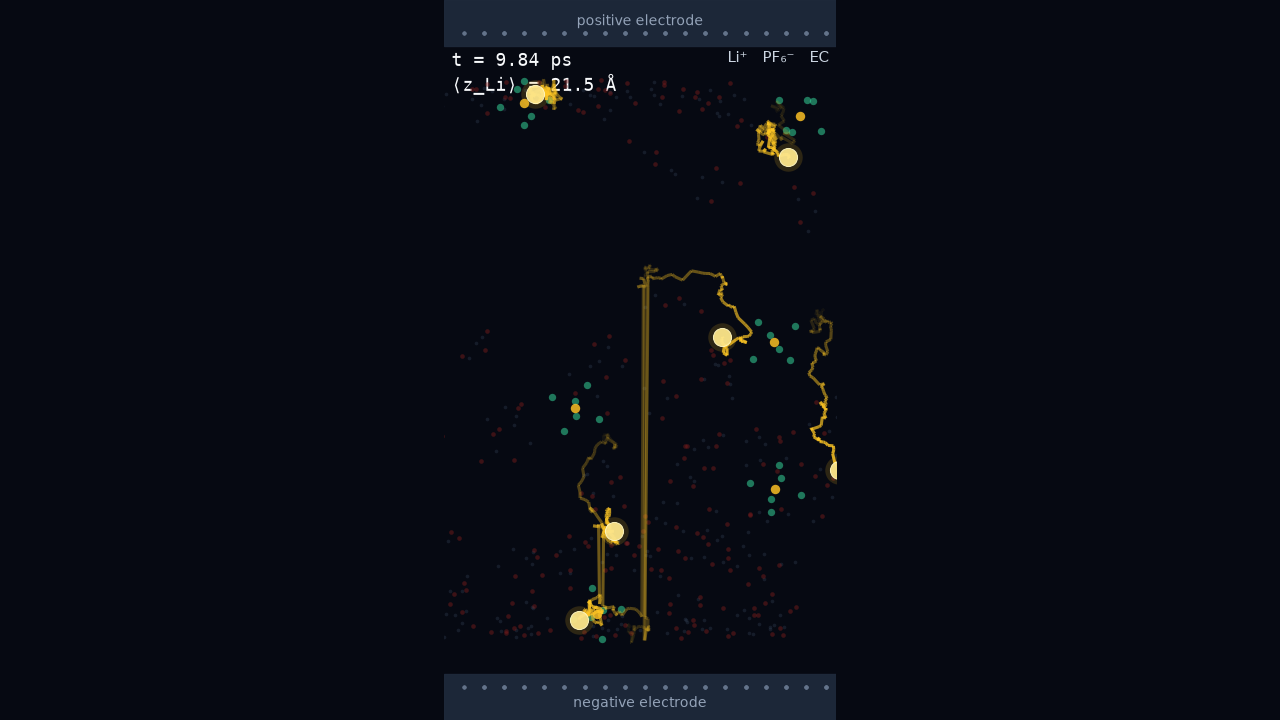
- Mean Li⁺ z falls from 25.1 Å to 21.5 Å once the field turns on — electrophoretic drift toward the negative electrode.
- Each Li⁺ keeps a first-shell oxygen coordination of ~3–4 (carbonyl + ether oxygens of EC within 2.8 Å). The ions stay solvated; the cell does not explode.
- PF₆⁻ sits as intact octahedra. Some Li⁺ share an anion — the contact ion pairs Tenney and Cygan counted in bulk electrolytes, now visible next to a wall.
That is the charging current at atomic resolution: cations walk downhill in the potential, dragging their solvation shells, while the solvent rearranges around them.
What this workflow needs from the product
1. Molecular topologies are just another project file
Battery electrolytes are not a single pair_style eam line.
They need a read_data file with atom types, charges, bonds,
and angles. QuickMDSim stages every project file into the job workdir.
Upload data.lammps next to the input.
2. KSPACE and MOLECULE are in the container
Long-range Coulomb (PPPM) and bonded molecule styles are compiled in.
A slab correction (kspace_modify slab 3.0) lets you put
real walls on boundary p p f without a 3D-periodic artifact.
3. Movies and dumps land in Outputs
The input writes movie.mp4, numbered snapshots, the custom
dump, and li_z.txt (mean Li z versus step). Open
the job and the movie plays inline.
Demo files
The project lives in the repo at demos/li-ion-electrolyte/:
input.lammps— NVT, field, movie, dump, Li-z logdata.lammps— walls + EC + LiPF₆ topologyREADME.md— parameter sources and geometry
Regenerate the data file with
python3 scripts/gen_li_ion_electrolyte.py.
There is also a one-click starter in the app — Li-ion electrolyte.
How to try it
- Open app.quickmdsim.com
- Pick the Li-ion electrolyte starter (or upload the two demo files)
- Press Run
- Watch
movie.mp4, then colordump.electrolyte.lammpstrjby type in OVITO. Li is type 1.
Credit
This is an educational cell sized for a free-tier run, not a reproduction of any one paper’s production trajectory. Cite the sources above if you take the parameters into research. Xu (2014) for the electrolyte landscape; Åqvist, Lopes & Pádua, Soetens, and OPLS-AA for the numbers; Tenney & Cygan and Boyer et al. for what to look at once the dump is on disk.